




3D Printing
3D Printing
Before we try to understand what is meant by 3D printing, let us watch a 3D printer print a small replica of Eiffel Tower.
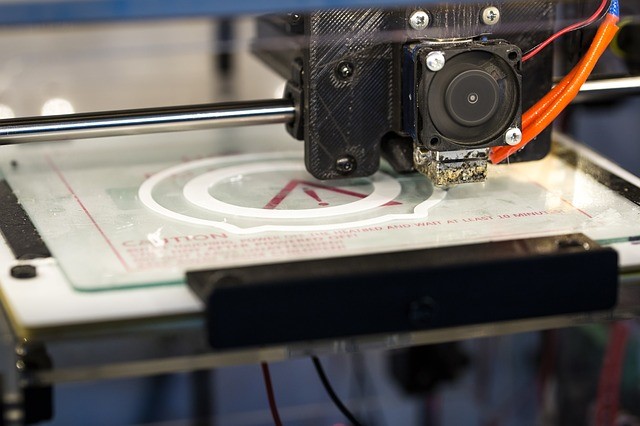
Now that you watched a 3Dprinter in action, let us get down to basics. While we are familiar with normal printers where documents are produced, we can now understand that 3D printer can be used to actually build replicas or samples of real objects. This makes them one of the most complex and modern machine tools similar to CNC machines.
What is 3D printing?
In a normal machine tool or manufacturing process, we normally take a full block of raw material and then do various cutting operations to get the required shape. This is known as “Subtractive Manufacturing”. On the other hand, in 3D printing, objects are built layer by layer, stacked upon one another, one at a time. Hence this is called “Additive Manufacturing”.
Origins of 3D Printing
3D printing has been around for the past 25 years or more. As these were very costly at that time, they were known to very few commercial enterprises. It was also protected by patent. Now that patent has expired, the costs involved are getting reduced and today you can have 3D printer at home as a hobby!
Areas of 3D printing use
The application range for 3D printing is enormous and only our imagination will be a limiting factor.
- manufacture original parts/components
- build prototypes
- can be used to make artificial organs
- medical components like, stents, valves …
- …………. and so many other uses!
Types of 3D Printing Technology
We will discuss briefly some of the 3D printing technologies here. The terms used may be formidable.
Fused Deposition Modeling (FDM)
- Alternatively called Fused Filament Fabrication (FFF)
- Cheapest of 3D printing technology
- A spool of thermoplastic filament is loaded into the printer and fed through a printer nozzle.
- The nozzle is heated to the desired temperature cause the filament to melt.
- The nozzle is moved to the required spot laying down the molten material onto a build plate.
- The molten material falling on the build plate cools and solidifies.
- The nozzle is moved repeatedly to required spots to build one layer.
- Then on top of the current layer, the next layer is built.
- This process repeats until the object is complete.
Stereolithography(SLA)
- World’s first 3D printing technology
- Uses mirrors known as galvanometers or galvos, with one on X-axis and the other on Y-axis
- These galvos rapidly aim a laser beam across a vat of resin, curing and solidifying a cross section of object
- Again layer by layer is built to complete the object.
Digital Light Processing (DLP)
- The process is similar to SLA, but instead of galvos, a digital light projector is used to flash a single image of each layer all at once (or multiple flashes for larger parts)
- Can achieve faster printing rates compared to SLA
- Light is projected onto the resin using light-emitting diode(LED) screens or a UV light source that is directed to build surface by a Digital Micromirror Device(DMD)
Selective Laser Sintering (SLS)
Material Jetting (MJ)
Drop on Demand (DOD)
Sand Binder Jetting (SBJ)
Metal Binder Jetting (MBJ)
Direct Metal Laser Sintering (DMLS) / Selective Laser Melting (SLM)
Electron Beam Melting (EBM)
These are all various technologies used in 3D printing. Refer to the source articles to understand more about them.
Sources and Acknowledgment
We base our blog on the following resources and we express our gratitude to them
MakeUseOf
Founded in 2007, MakeUseOf is an online publication that issues tips and guides on the latest computer trends. We refer to their article on “Ultimate Beginner’s Guide to 3D Printing”.
All3DP.com
After seeing a bright future for 3D printing, All3DP.com was founded in 2014. Today, it is one of the world’s leading 3D printing magazine. We refer to their article “All 10 Types of 3D Printing Technology in 2019“
Embedded Computing Design
This is the website of OpenSystems Media who has been the leader in building engaging online, print, and live communities for more than 30 years. We refer to their post on “3D Printing explained and How it will rock the world“.